You have 0 items in your cart
Yogic breathing is the foundation of all pranayama exercises and in another way, a representation of fundamentally breathing. This process involves utilising deep, slow, diaphragmatic breaths. This practice or technique of breathing can also be referred to as ‘diaphragmatic breathing’ or ‘3-dimensional breathing’. Like any skill, it takes time to master the control of the respiratory system; it is a gradual process. Initially, many will need to awaken and tone the breathing muscle of the diaphragm. Being patient and practicing with focus and heartfelt commitment will help in the developmental process, which becomes easier with time as the diaphragm continues to strengthen, just like any other muscle in the body.
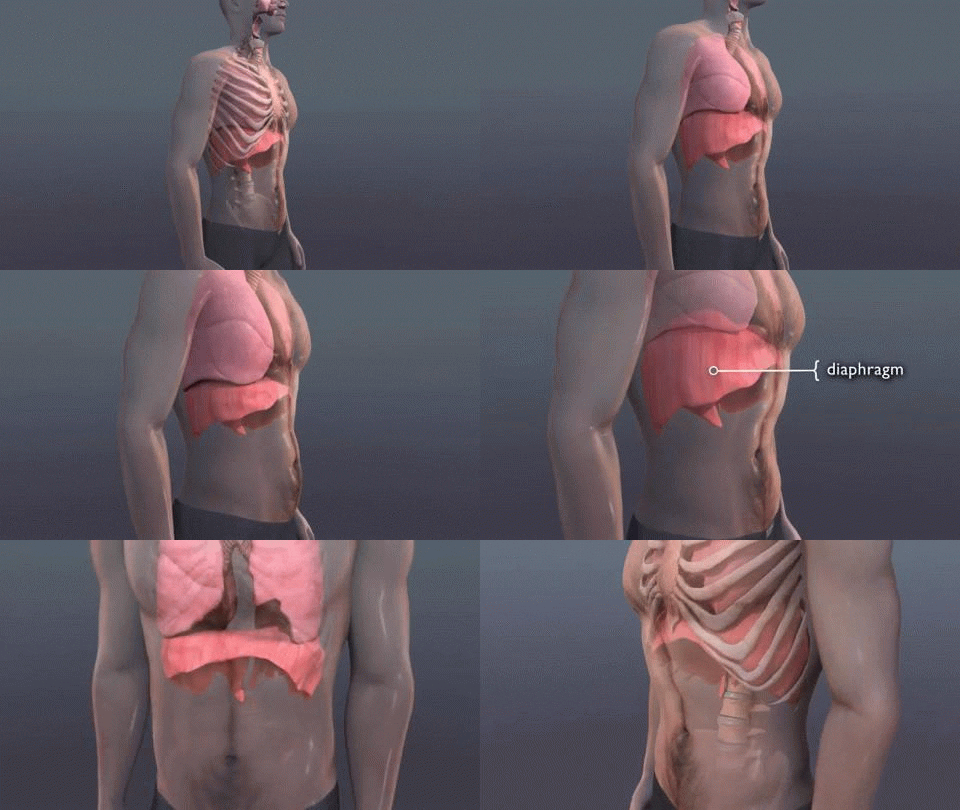
Yogic breathing is the foundation of all pranayama exercises and in another way, a representation of fundamentally breathing. This process involves utilising deep, slow, diaphragmatic breaths. This practice or technique of breathing can also be referred to as ‘diaphragmatic breathing’ or ‘3-dimensional breathing’. Like any skill, it takes time to master the control of the respiratory system; it is a gradual process. Initially, many will need to awaken and tone the breathing muscle of the diaphragm. Being patient and practicing with focus and heartfelt commitment will help in the developmental process, which becomes easier with time as the diaphragm continues to strengthen, just like any other muscle in the body.
Breath awareness is always the first step, whether it’s your first time or you’re a veteran. Pay attention to the breath in a felt way, feeling the movement of the natural breath. Notice the sensations of the breath. The coolness of the inhale and warmth of the exhale. Emphasise feeling here, the thinking mind is not needed in this step.
Relaxing the shoulders, ribs abdomen, take deep, long breaths into the bottom of the belly, allowing the breath to fill the chest cavity, feel it rise to the top of the chest. Again, no force or strain! It’s not your maximum effort but rather, a calmly full breath that moves into the abdominal region first, before moving towards the chest. The three-dimensional breath can be described as the torso expanding in all directions. The abdomen and rib cage expanding forwards, backwards and sideways, with a slight tilt upward.
It can be beneficial to imagine the inhalation in three parts within the torso:
The exhalation is one gradual contraction of the entire torso, feeling the control of the breath coming from the belly region, not the ribs or throat. It is critical that you perform this type of breathing gently. There is no force whatsoever. The expansion and contraction of the torso is a passive function, not active. This won’t be the absolute deepest breath you’re capable of breathing, rather is a comfortably full breath while remaining with soft muscles through the belly, ribs and shoulders.
Yogic breathing is gradual, controlled, even, smooth, rhythmic, and tidal. Most of all, this breath is by conscious choice, rather than automatic body function. After learning this type of deep, slow breathing, all other practices of pranayama follow.
Try this type of breathing with a 6 second count in and 6 seconds out (ratio 1:1 – 6 in 6 out). Once that is relatively comfortable and smooth for a several rounds, you are ready to begin more formal pranayama practices.